
What are the four immeasurables?


You don’t have to spend long in the world of Tibetan Buddhism before coming across the four immeasurables. They are often recited at the end of a meditation session or class. On first hearing, most people find them wonderfully appealing, if extraordinarily idealistic. They are certainly an exquisite embodiment of the purpose of Tibetan Buddhism.
But what they mean, exactly, and the depth of their personal significance isn’t something that’s often explained. Like so many other aspects of the Dharma, truly understanding them is the journey of at least one lifetime.
I thought it may be helpful to provide a few introductory words about them here.
May all beings have happiness and the true causes of happiness.
May all beings be free from suffering and the true causes of suffering.
May all beings never be parted from the happiness that is without suffering, great nirvana liberation.
May all beings abide in equanimity, free from attachment, aversion and free from ignorance.
Why ‘immeasurables’?
Each of these four lines applies to an immeasurable number of beings. The scope of our wishes is not only our family, friends or whoever is the focus of our usual attention. We are not interested solely on the small circle of beings to whom we are partial. As we recite these lines we are deliberately stepping back and widening our perspective to include all beings, most of whom we generally think of as strangers.
‘Beings’ here includes all those possessing consciousness – we are embracing not only our pets but other sem chens - Tibetan for ‘mind havers’ - also. The objects of our wishes, karmically speaking, is without limit, which is why it is so powerful to acquaint our mind with this way of thinking.
What does each line mean?
To a newcomer, the four immeasurables may seem impossibly utopian, but their purpose has as much to do with what’s going on in our own minds as what’s happening in external reality. In time, of course, we will come to understand how much the one is a projection of the other!
To help us get there, we are deliberately shifting the way we think. We are cultivating those mental qualities that are the cause for true wellbeing and adopting a more panoramic vision.
The four immeasurables help move us in this direction by offering a reminder of the qualities we most wish to cultivate, namely:
Pure, great love: May all beings have happiness and the true causes of happiness.
Love, in Buddhist terminology, is the wish to give happiness to others.
When love is ‘pure’, there is no expectation of reciprocity. It is a ‘no strings attached’ motivation. If we love a person or animal according to this quality, we want the best for them and their wellbeing, irrespective of where that leaves us.
When love is ‘great,’ it applies to all living beings, not only our small cherished circle.
In wishing for their happiness, we include ‘the true causes of happiness.’ These are inner qualities rather than external conditions, and they may be summarised as love, compassion and equanimity.
Pure, great compassion: May all beings be free from suffering and the true causes of suffering.
Compassion is the wish to free others from suffering, and once again we seek an attitude that expects no return – pure – and is extended to all those who suffer – great.
What are the true causes of suffering? In Buddhist terms these are the ‘three delusions’ which go by a number of different names – ‘attachment’, also sometimes called craving or desire. ‘Aversion’, also referred to as hatred or anger. And ‘ignorance’, meaning, ignorance of how things exist, especially that the way they exist is, mostly, a projection of our own mind.
The three delusions is a profound subject worthy of its own post and hinted at in just about every article I write.
Pure, great joy: May all beings never be parted from the happiness that is without suffering, great nirvana liberation.
This line underlines the permanent kind of happiness we are wishing others. A permanence attained when a person has realised shunyata, the nature of reality, directly for themselves.
What we are wishing is for all beings to experience the joy of this realisation, which can never be lost. Once we have understood shunyata, we can never revert to a state where we no longer understand it, hence its game-changing quality. Our samsara, meaning our karma and delusions, come to an end when we understand shunyata. We are beyond being fooled by appearances.
Pure, great equanimity: May all beings abide in equanimity, free from attachment, aversion, and free from ignorance.
Equanimity is a state of mind when we see reality for what it is: nothing has any inherent existence and the way it seems for every being depends on what that being’s karma is forcing him or her to see.
As a consequence, there is no longer the reflexive categorising of others as friends, enemies and strangers. All beings have the same basic wishes for happiness and to avoid suffering. They all suffer from karma that attracts them to some things and people and repels them from others. We wish for every living being to be free from such karma and delusion and come to a state of equanimity.
My kind and precious teacher, Les Sheehy, will sometimes recite the four immeasurables then, at the end, for good measure, reiterate them directly with the line:
“May love, compassion, joy and equanimity pervade the hearts and minds of all limitless beings throughout universal space.”
I love this encapsulation of them, forming a dedication both poetic and powerful.
The four excellences
So much for the definitions of the four immeasurables. As individual practitioners, our job is not simply to understand their meaning, but to acquaint our minds with them, to make them part of who we are, and ultimately to embody them.
The process by which we do this may be summarised as the four excellences. These apply to many Dharma concepts and represent subtle and life-changing psychology.
The first excellence is accepting the four immeasurables as a valid aspiration. Having had a chance to consider and interrogate them at different times and from different angles, we may very well come around to thinking of them as representing the most ambitious and benevolent vision we have ever encountered. I know I certainly did. Logical reasoning, the bedrock of a settled confidence, is the basis of this first excellence.
As we become familiar with the four immeasurables, they engage us at a deeper level. They are no longer appeal to our minds alone but also engage our imagination and our emotions. They become a heartfelt wish. Perhaps we have a brief taste of what it may be like to experience a quality like pure, great love or pure, great compassion. Maybe through our teacher, during meditation or on a retreat we catch a glimpse of how we may abide in a mind free of relentless chatter and judgement. Wouldn’t it be great if all beings could experience this and if their actions arose from such a place, rather than from states of agitation and delusion?
As this heartfelt wish deepens and our practice evolves further, we increasingly recognise our own incomprehensibly good fortune. How is it that I have somehow stumbled upon such wisdom? Looking around the world, here and now, what impossibly small odds are they that I have found my way to these wisdom teachings that reveal such a meaningful purpose for my life?
If I truly believe that all other beings are just like me in seeking happiness and wishing to avoid suffering, what can I do to help turn this heartfelt wish into a reality? Taking personal responsibility is the third excellence. We decide that there can be no greater meaning to what we do than to help actualise the four immeasurables according to our capabilities and circumstances. They are no longer merely pretty ideas. We have also stepped beyond them being emotionally engaging ones alone. Now they provide a broad agenda for how we live. We want to do what we can to help make them come to be.
Much as we may wish to help all living beings throughout universal space, our capacity to do so is rather limited! At least, it is so long as our self-concept is one of a bag of meat and bones, perhaps of a certain age, with all kinds of idiosyncrasies, foibles and limitations. But what if we were boundless consciousness imbued with qualities like compassion, wisdom and power, acting spontaneously and non-conceptually for the benefit of others? What then?
A ‘blessing’ in Tibetan Buddhism is defined as ‘the capacity to change,’ and when practitioners invoke the blessings of Buddhas we are not doing so as inherently-existent people asking inherently-existent enlightened ones to give us inherently-existent qualities. We are, rather, seeking the capacity to change - to actualise the qualities we seek by deliberately bringing our own mind closer to the visualised embodiments of them. We are not worshipping Buddhas so much as seeking nonduality with them.
What happens when we invoke the Buddhas to help us do this is the fourth excellence. On the basis that it is the best possible investment of our time and energy we seek to to attain enlightenment to actualise this wish. We cultivate bodhichitta – the mind of enlightenment.
Such transformation is dramatically accelerated by the many practices found in Tibetan Buddhism to attain oneness with the Buddhas, be they Shakyamuni, the historical Buddha of the sutras, or yidams like Tara, Manjushri, Chenrezig, Vajrapani and many others.
Sharing with others
While the four immeasurables are increasingly profound and consequential as we come to know them better, they are also a very socially-acceptable way to offer Tibetan Buddhist concepts to others.
I have been asked on occasion, by a well-meaning Christian friend - who assumes that all Christian practices have their Buddhist equivalent - to say grace before a meal. There are other moments when you may find yourself called upon to offer a Buddhist prayer. The four immeasurables are a wonderful offering on such occasions.
Summary
The four immeasurables provide us with Tibetan Buddhist definitions of love, compassion, joy and equanimity. In each case, the qualities we aspire to are ‘pure’ – that is, free from self-interest - and ‘great’ – applying to all beings without exception.
Although each line appears deceptively simple, it is freighted with the most powerful significance, which represents a lifetime’s journey to understand fully.
In seeking to move the four immeasurables from surface-level concept to embodiment, we may use the four excellences. These lead us, step by step, from a rational then heartfelt acceptance, to a sense of personal responsibility, prompting an added urgency to our goal of transformation for the sake of others – bodhichitta.

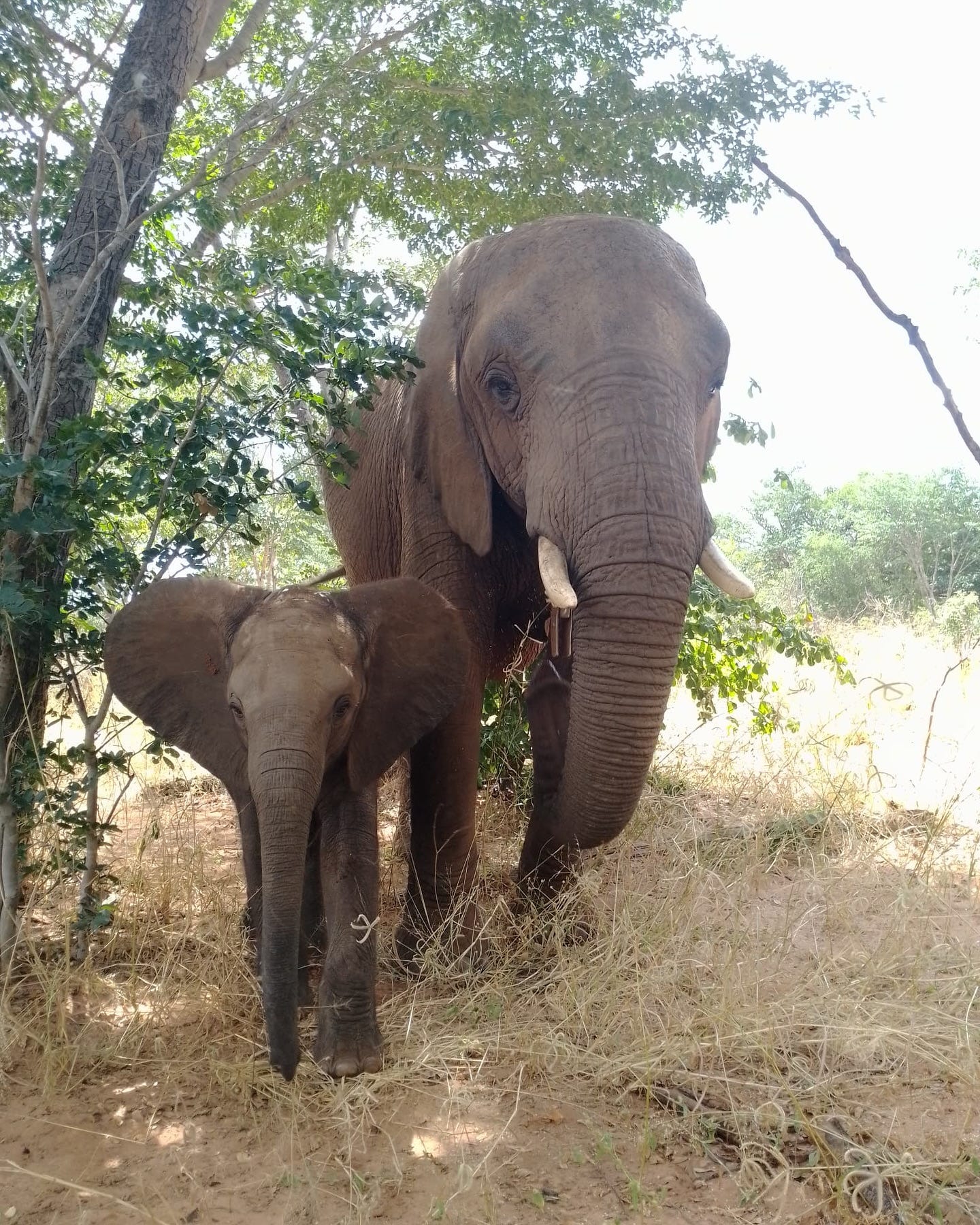
Photo: Little Maggie with Norah
I sense a heartfelt connection between this week’s post and the following brief update this week from Wild is Life/Zimbabwe Elephant Nursery, one of the charities you support as a subscriber of this newsletter.
“Norah didn’t give birth to little Maggie - but from the moment they met, she chose her. With gentle trunk touches, watchful eyes, and patient steps, Norah has become the mother Maggie never had…
Elephants are deeply emotional, family-driven beings. They mourn, they protect, they love fiercely.
And sometimes, just like us, they make space in their hearts for those who need it most.
In Norah’s care, Maggie is thriving. And in their bond, we’re reminded that family is not just about biology - it’s about love, protection, and presence.
I am so grateful for your work, your writing and the support you give to animals and humans in need. And I am so grateful to be able to offer my support for the work that you do. Blessings indeed! Thank you.
Thank you so much for your wonderful words!