
The Golden Road
How the Buddha - and India - came to the world. Fascinating!

Dear Readers,
Before sharing this weekend’s post, I want to respond to the extraordinary number of messages you sent after last week’s offering from Mary Magdalene’s Cat.
Wow!
Given the warmth of your responses, you may find it hard to believe that I was rather apprehensive about how the post would be received. It was new territory for me as a writer – though not as a practitioner – and I worried that some of you might feel I was straying from familiar ground.
It seems not. Quite the opposite, in fact. I’m absolutely delighted to know this, and Mary Magdalene’s Cat has been enthusiastically encouraged to channel more.
I’m sorry not to have replied individually to all your kind comments. There were simply too many! I suspect you would rather I focus my time on sharing more of the story – which I plan to do later this month.
And to those concerned that HHC has somehow been forgotten: have you taken complete leave of your senses, dear reader? You’ll certainly be hearing from her again!
In the meantime, here’s a post on one of the most remarkable books I’ve read in a long time…
Sitting in the gompa, listening to my teachers speak about one practice or another, I sometimes find myself wondering: what would Shakyamuni Buddha make of all this? Of the statues and thangkas, the rituals and ceremonies? How did the teachings of an enlightened yogi in ancient India travel across centuries and continents to reach me here, in my small Western bubble of privilege, 2,400 years later – and still retain such undiminished relevance?
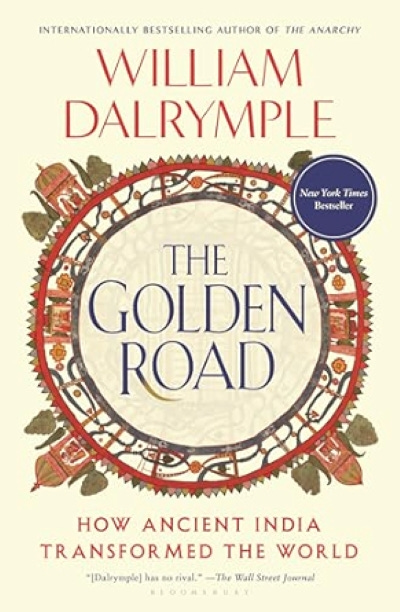
For a long time I assumed the answer lay largely in recent history. The Golden Road shows just how mistaken that assumption was.
I have long been a fan of William Dalrymple, who lives in India and is a born storyteller. He draws readers into his world with infectious enthusiasm and an unending supply of dazzling narrative twists and turns. Like his previous books, this one is meticulously researched: the illustrated footnotes alone occupy nearly a third of its pages and offer rabbit holes aplenty for anyone inclined to disappear down them.
The Golden Road is many things. Above all, it is a richly engaging account of how profoundly ancient India shaped Western culture, commerce and philosophy – right down to the very numbers we use in our decimal system.
In the words of a reviewer from The Independent newspaper: “The history book that will transform your view of early civilisation … Forget the Silk Roads, it’s the Golden Road we should be celebrating. Dalrymple argues that, thanks to its major role in global trade between AD 300 and 600, it’s India, rather than China, to which we owe some of the most important developments in human civilisation ... A multifarious and engaging narrative, which, like Indian trade, takes us in many directions, peppered with lively stories and charismatic individuals. It will make you look at the world differently.”
What intrigued me most were the book’s answers to questions I have often pondered about Buddhism’s early evolution. These insights are brought to life through a wealth of vivid stories, such as the extraordinary rise of a fifth-ranking concubine to become Empress Wu of China, whose ruthless reign established Buddhism as the state religion – in the nation that is still home to the largest Buddhist population in the world.
From a small, local group to one of the world’s great religions
Dalrymple sketches the life of Shakyamuni Buddha and the foundations of his teaching with admirable clarity. Yet for the first two centuries after his death, there was not a shred of archaeological evidence to suggest he had even existed. The situation was transformed by the conversion of Emperor Ashoka to Buddhism – a development so momentous that it deserves a post in its own right.
“The Emperor Ashoka was one of the most remarkable figures in all Indian history. He was also the man who helped raise Buddhism from what was still effectively a relatively small, even local cult, into one of the world’s great religions.”
It was thanks to Ashoka that Buddhism spread, first throughout India. Dalrymple describes Buddhism like this:
“The doctrine of the Buddha was at once a philosophy, an ideology and a method, a practical spiritual path of mental training and discipline that he assured his followers would free them from the pain inherent in existence.”
From the beginning, a spiritual tradition for all
As revealed in the extraordinary Ajanta caves, where some of the earliest Buddhist art ever created can be seen to this day - and which my friend Laurel Ramey, recently shared in her beautifully illustrated post - from the beginning, Buddhism was a tradition for all: “The artists of Ajanta clearly saw nothing odd in this juxtaposition of monks and dancing girls, ascetics and princesses. There are no panels or boundaries in the Ajanta paintings … There is also a surprisingly international cast of characters in the murals. Recognisable among the crowds are many foreigners, including Persians, Parthians, Scythians, Ethiopians, Egyptians and even Greeks and Romans …”
What also caught my eye about this early Ajanta cave art was how: “In all this early art, you feel strongly the Buddhist intuition that the natural and animal worlds are closely related to humankind through great cycles of reincarnation … Animals are therefore depicted with the same love and respect as humans … ethical living requires treading softly on this earth …”
Dalrymple reminds us that although the Silk and Spice Roads loom large in the popular imagination – names bestowed only in modern times – the most efficient link between India and the Mediterranean was always the sea route. Trade between the two worlds was already well established, but the Battle of Actium in 31 BC transformed its scale and significance. Octavian’s victory over the combined forces of Mark Antony and Cleopatra near Actium in Greece made him undisputed ruler of the Roman Republic and signalled the dawn of the Roman Empire.
The huge scale of East-West trade
“ … such was the scale of the Red Sea trade at this period that the customs taxes raised by Roman officials on the trade coming through the Red Sea would alone have covered around one-third of the entire revenues that the Roman Empire required to administer its global conquests and maintain its legions, from Scotland to the borders of Persia and from the Sahara to the banks of the Rhine and Danube.”
For several centuries from the beginning of the Common Era, Rome and ancient India were major trading partners, with hundreds of large cargo ships sailing in each direction every year. Drawing on India’s long shipbuilding tradition, these sturdy vessels were capable of carrying up to 1,000 passengers or as many as 3,000 amphorae of goods.
Pliny the Elder complained bitterly in his Natural History about the drain of Roman wealth – especially gold and silver – flowing east to India, Arabia and China to pay for luxury imports such as spices, silk, perfumes and gemstones. In modern terms, he estimated, this amounted to the equivalent of roughly $1.5–2 billion a year.
Indian exports reached far beyond the Roman elite to ordinary people across the empire. As a result, Tamil and Sanskrit words for everyday commodities – sugar, ginger, pepper, sandalwood, cotton and indigo – made their way into Latin and, eventually, into English.
Nalanda: the Harvard of ancient Asia
Back in India, Buddhist university monasteries were reaching their zenith. A visiting Chinese scholar, Xuanzang, was astounded by what he encountered in the 7th century – and which Dalrymple amusingly describes as the Harvard or MIT of ancient Asia:
‘Lectures at Nalanda were given in a hundred different halls each day, (Xuanzan) wrote, ‘and the students studied diligently without wasting a single moment’. He described the lecture halls, the stupa relic mound, five temples and 300 apartments and dormitories which housed the 10,000 monks and international scholars who gathered there. Between them they studied the texts of the different schools of Buddhism, as well as the sacred Vedas, logic, Sanskrit grammar, philosophy, medicine, metaphysics, divination, mathematics, astronomy, literature and magic. The priests of Nalanda, to the number of several thousands, are men of the highest ability and talent,’ he wrote. ‘Their distinction is very great at the present time. The day is not sufficient for asking and answering profound questions. From morning until night they engage in discussions; the old and the young mutually help each other.’
Buddhism did not remain solely the preserve of wandering ascetics modelled on the Buddha himself. From its earliest days it also drew in lay practitioners – especially merchants – whose material support made the monastic life possible. The relationship was there from the start: the Buddha’s first lay devotees were two traders who brought him a simple meal of gruel and honey after his enlightenment.
How the merchant classes helped promote Dharma
Early Buddhist texts frequently portray merchants in a positive light, celebrating both their commercial skill and their capacity for generosity. Prosperity was seen as a karmic outcome of earlier good deeds and thus something to be acknowledged with gratitude. This attitude helped lay the groundwork for the rise of Mahayana Buddhism, with its expansive ideal of enlightenment dedicated to the welfare of all sentient beings. The Theravada path, by contrast, placed greater emphasis on personal liberation, typically sought through a life of simplicity and renunciation.
“No wonder foreigners, and especially foreign Buddhists, were welcomed with open arms at these monasteries and appear so frequently in their murals: the wealth they generated and showered on these communities was one of the driving forces that financed the growth and prosperity of the Indian Buddhist monastic movement. In turn, the monks would help take the religious ideas of the Buddha, first dreamed up far inland between the Himalayas and the Ganges, out into a much wider world, west via the Red Sea to Alexandria; south to Sri Lanka; and east, from Bengal, Orissa or the Andhra coast to Suvarnabhumi, the Lands of Gold: Burma, Thailand, Java, Sumatra, Cambodia and Vietnam.”
Spiritual and cultural cross-fertilisation
Alongside trade goods and Buddhist ideas, Dalrymple describes how craftsmen in Egyptian ports became familiar with Indian iconography, and how some of Aesop’s Fables appear to trace their origins to Buddhist Jataka tales. Even the Christian story of Barlaam and Josaphat seems to have been adapted from Buddhist sources. Buddhism itself established tentative footholds in Egypt at roughly the same time that Thomas, one of the twelve disciples, is said to have arrived in Kerala in the first century CE, founding a Christian community that has endured there ever since.
Reading this book, one realises that the notion of Jesus needing to travel to India to encounter Eastern traditions, including Buddhism, is largely unnecessary. While Gandharan monks may not have been regular visitors to Judea, Indian sailors carrying goods to Mediterranean ports could easily have been Buddhists, and many would doubtless have been able to explain their beliefs and practices with clarity.
The cultural exchange also flowed in the opposite direction. Western ideas and artistic styles travelled east, where Buddhist sculptors in Gandhara produced works strongly influenced by Roman models. The earliest representations of the Buddha show him with hair arranged in the Romano-Greek style, unmistakably echoing contemporary depictions of Apollo.
“For Gandharan imitations of classical art rarely misunderstand their classical western models, and the sculptors show complete familiarity with the rules of Graeco-Roman art, while brilliantly transforming it for use in Buddhist worship and cross-fertilising it with Indian motifs and imagery. This supports the notion that living Roman artists may have been present in Gandhara in person during the development of its Buddhist art, collaborating with and instructing local craftsmen. It is also quite possible that these itinerant sculptors were from pagan Graeco-Romano-Egyptian backgrounds, perhaps fleeing the Christian takeover of Egypt and the increasingly violent persecution there of all pagans and non-Orthodox Christians.”
For most of my life, I assumed the West’s encounter with Buddhism was relatively recent — a modern meeting of traditions. The Golden Road reveals how mistaken that view is. Buddhism was known in the West before the time of Jesus. The statues of the Buddha we recognise so instantly were shaped by Greco-Roman aesthetics. Even the words we use — mind, mother, father — and the numbers we count with carry the imprint of ancient India.
What Dalrymple offers is not just historical correction, but perspective. Suddenly the Dharma I have received in a gompa in Western Australia feels less like a transplant and more like a homecoming.
This book deepened my appreciation not only of Buddhism’s journey through history, but of how profoundly interconnected our civilisations have always been. Whether we realise it or not, we are all heirs to the Golden Road.
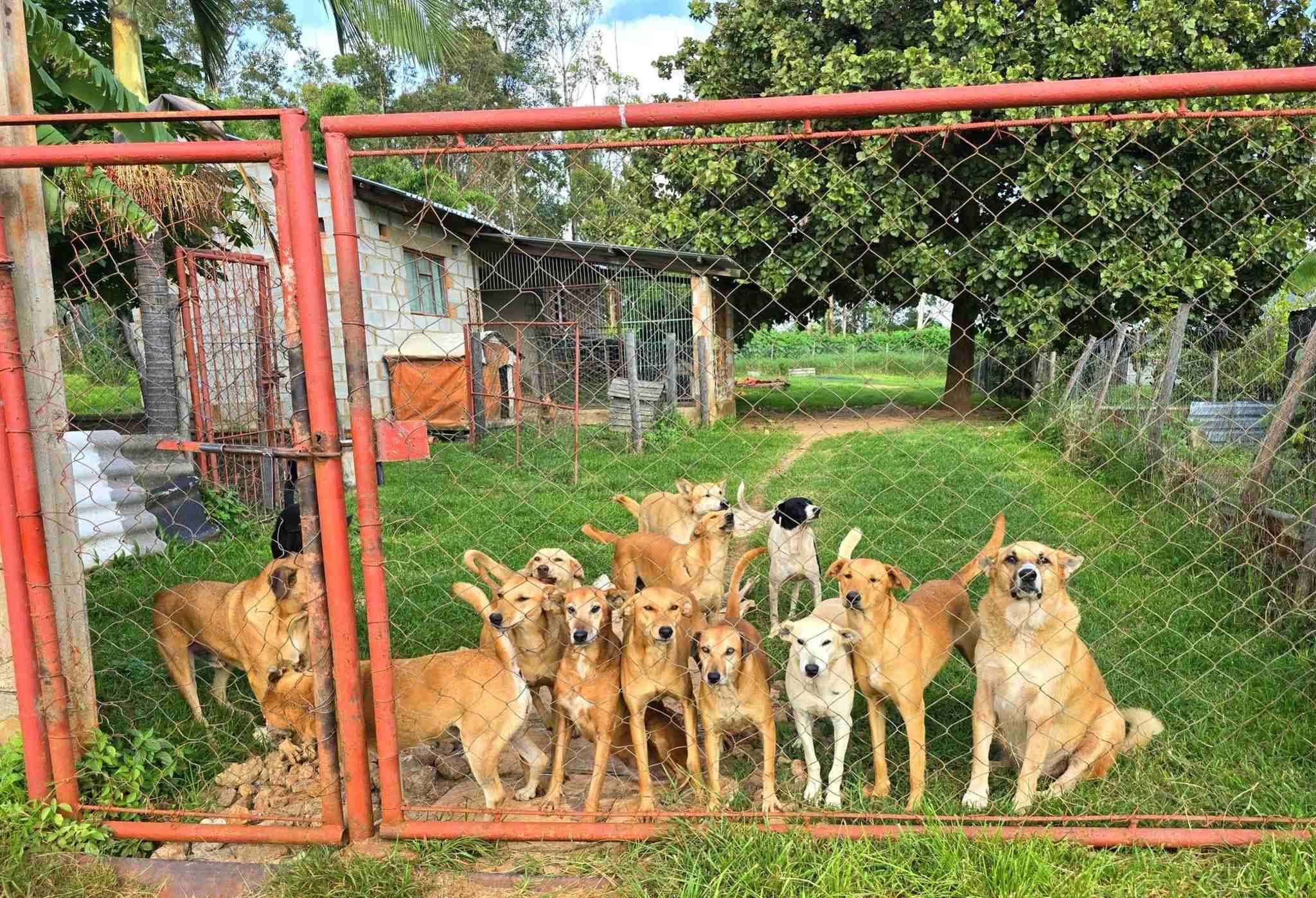
Photo: The Compound Gang - part of the Waggley Tail Club at Twala. All surrendered or rescued. Now living the happiest life in our kennel free sanctuary.
This week’s photo update comes from Twala Trust Animal Sanctuary, one of the three non-profits you support as a paying subscriber. I love how lush my home country looks in the ‘green season.’
Over to Sarah:
“Doggy Tuesday is the best day of the week for many dogs - and now cats - in our area. We are so happy to be able to provide lifetime care to rural dogs, and cats too, through this long standing community outreach programme.
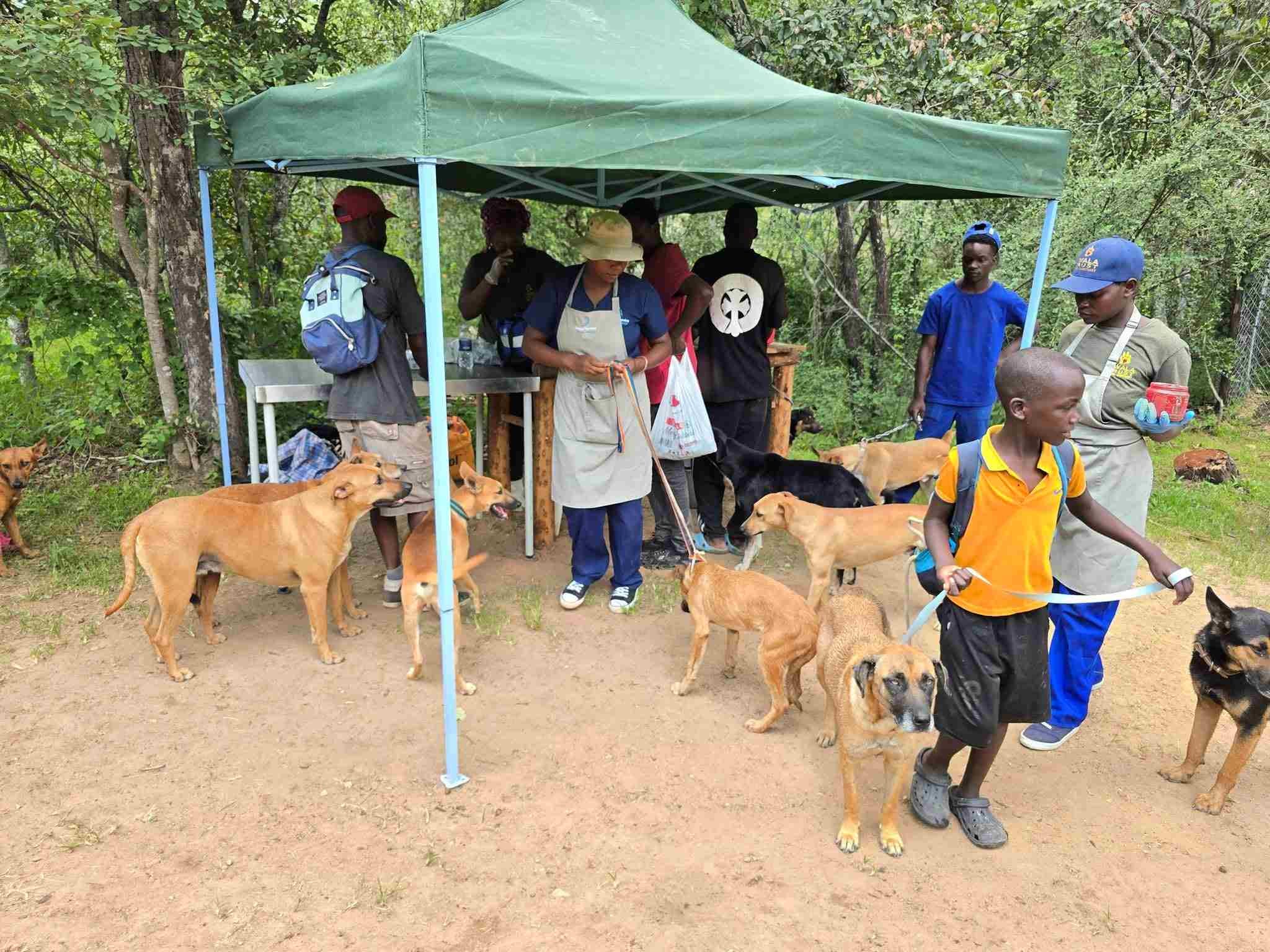
Photo: Checking in.
Many dogs arrive with bits of string, chain or broken collars held together with wire. We replace these with comfortable, safe leashes donated by our wonderful volunteers and supporters.
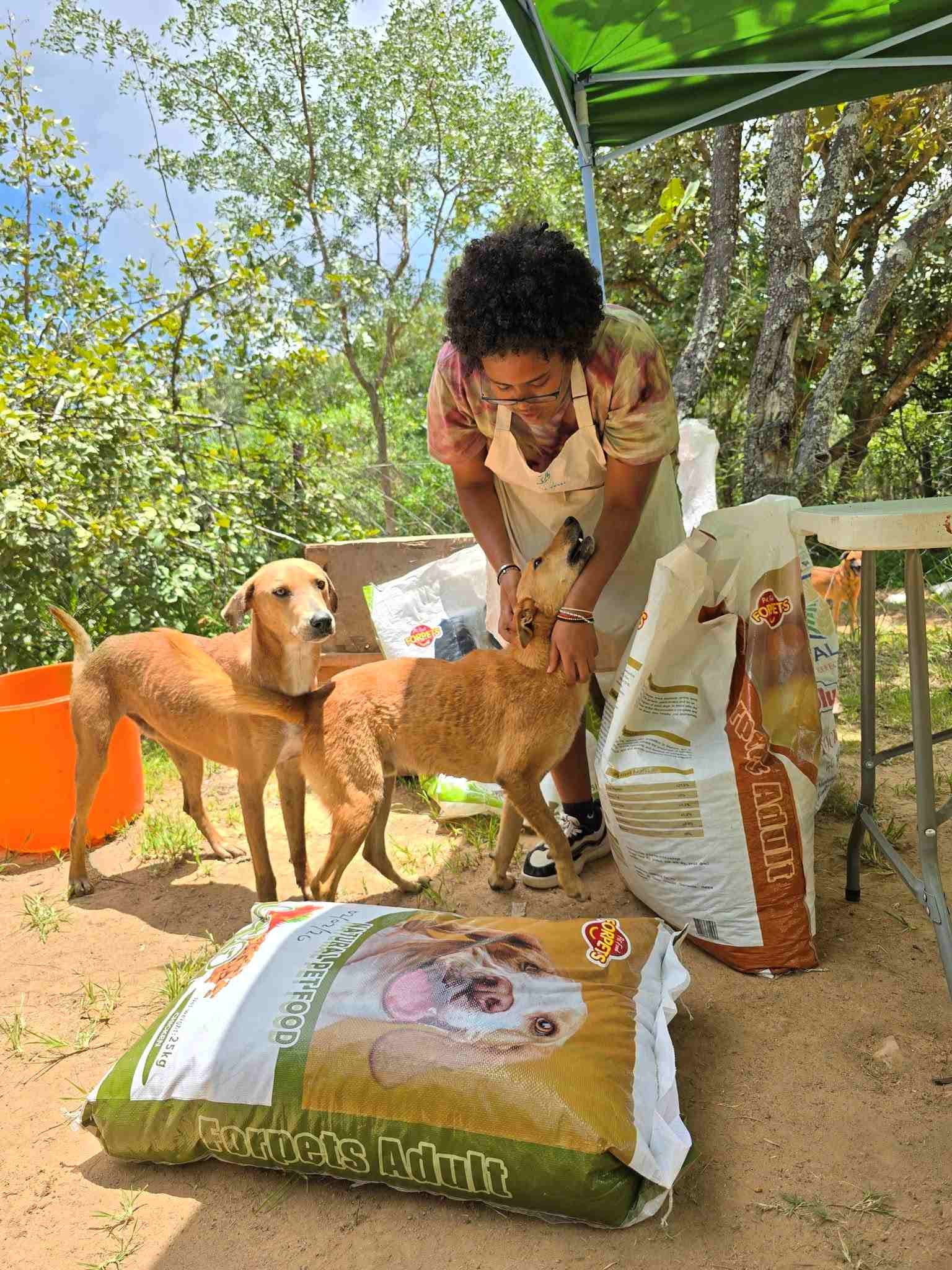
Photo: Volunteer Argy with a Doggy Tuesday regular, Compressor, who always has A LOT to say!

Photo: If life was a tennis match, Walter would be serving aces. This darling little boy, rescued after traveling in a car engine from Goromonzi to Harare, is available for adoption. Twala adoption policies apply.

Photo: Sylvie the serval happily plays in the rain. Servals have wonderful thick coats to keep them dry and warm. You can see her broken tail from where she was caught by dogs on a farm.”
Hi Everyone,
David here again. To all my paying subscribers, thank you so much for helping creatures great and small through the three non-profits we support – and for encouraging me in my writing.
I feel deeply grateful to be part of this nurturing and ever-widening circle of kindred spirits, all of us actively trying to be the change we wish to see in the world.
There are people and animals in Africa, right now, whose lives are immeasurably better because of you.
Warmest wishes,
David
Hi David, Somebody new to read for me. I so enjoyed Laurels article on the caves, I want to learn more too. I never even knew they existed.
Thanks for the summary and the update on Twala. Those pack of dogs, sure look happy.
Absolutely! India was the foundation for much of what we enjoy today. Regarding Buddhism as a religion: personally I have never viewed it as such. For me Buddhism is more akin to a lifestyle. One that, if adopted widely, would transform human society.
Thanks for another great post.