

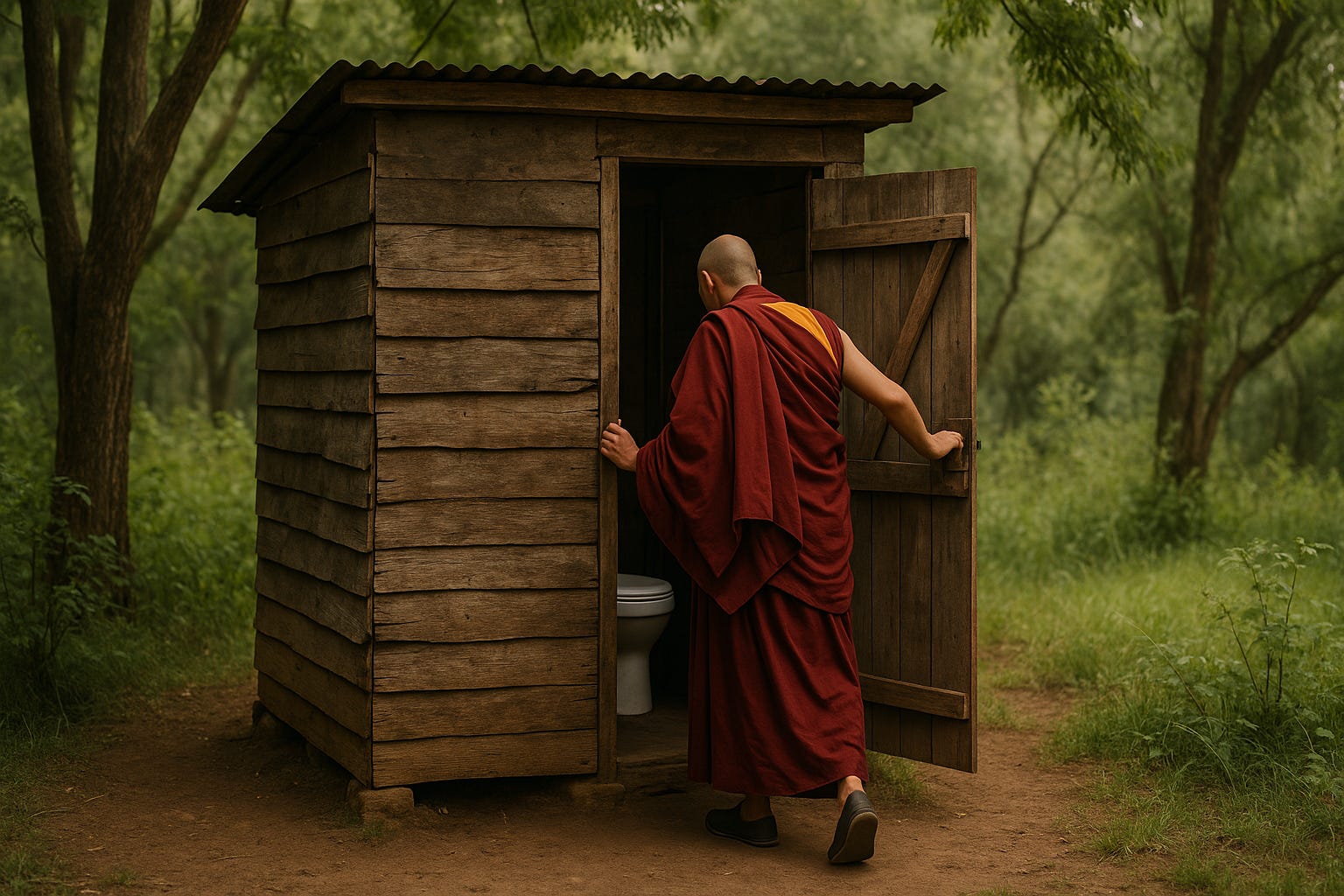
I am actually quite nervous about this week’s post because it involves a subject you may find a bit uncomfortable, strange or distasteful. But to me it is such a powerful daily reminder of the Buddha’s most important teaching. I am referring to pooping. And shunyata.
Rest assured I will spare you the lavatorial details. But the daily ritual offers such enormous scope for profound analysis that it would be remiss of me not to write about it. I also feel that you, my dear readers, are sufficiently mature enough to handle the subject without having your sensibilities offended! However, if this is a subject that really grosses you out, please stop reading now.
It’s hard to think of a more vivid example of shunyata than how what passes out of our body, something that smells and looks disgusting may have been, only a day or two ago, a delicious meal. What we leave behind in the toilet bowl is decidedly not that delicious meal. But nor is it unrelated to it. We may say that it is a continuity of it. That it is the result of that meal after a transition period. That the meal gave rise to the poop.
Impermanence
We may use our time on the lavatory as an opportunity to reflect on impermanence. On the Buddha’s teaching that nothing is fixed and unchanging. How everything is rather in transition.
A tasty dinner is an especially striking example. Perhaps what is now in the toilet was a wonderful treat cooked by a friend, family member or one we prepared ourselves. Maybe it was a restaurant meal for which we paid a lot of money. Willingly! Perhaps so strikingly presented that we even took a photo of it to share on Instagram.
How things change!
After we flush the toilet, they change again. What is currently in the pan goes into the sewers - ‘wastewater’ that, along with a lot of cistern water and other stuff will end up in a sewage treatment plant. Biosolids find their way to farms. Treated water is discharged into rivers, aquifers or oceans, eventually evaporating, before falling as rain. Who knows, we may drink it in one form or another. Just like we did in our last lifetime, and all the lifetimes before that. How many times, exactly, has it been through us?
All is impermanent, in a state of transition.
Me, too.
There is nothing fixed about me. Just like that meal, I represent the coming together of all manner of items, physical and mental. I am continually changing depending on what I eat, what external influences I am exposed to – viruses, healthy or toxic nutrition, relationships, ideas – never staying the same. Even physically speaking, scientists tell us that we don’t have a single cell in our body more than seven years old. And a lot of our cells are constantly dying and being replenished.
Just as the temporary concept of a delicious meal came to an end as we ate it, so will the concept of ‘me’ as I die. But it is not a complete end. Only a milestone on the continuity of discontinuity as lamas sometimes put it. Our bodies will probably be changed to energy and ash. Our subtle consciousness will experience reality as something markedly different – but one not unrelated to what precedes it – underlining the importance of mind training, of creating instinctive impulses that will produce a serene, nurturing, loving reality rather than their opposites.
The absence of inherent qualities
Much of the time we are caught up in the same collective trance as the people around us in believing that reality comes entirely from outside us. That the people, actions and things in our experience have qualities making them attractive or unattractive that are inherent to them. That the way they exist has nothing really to do with us – we are merely objective, ‘innocent’ observers.
We may choose to use our lavatory time to challenge this misleading, self-damaging assumption. To remind ourselves just how much our reality is produced by the karma arising in our mind.
Thinking about the meal we ate: was it inherently delicious? Put another way, would anyone who had been offered it respond the same way that we did?
We don’t have to think for long to see how impossible this idea is. The same food that has us salivating has other people wrinkling their noses. There is no such thing as objective deliciousness.
We, ourselves, may have found our palettes change: I hated avocados growing up, when we had a tree that produced so many that they used to rain to the ground every time there was a strong wind. Later in life, without a Magic Avo tree, I surprise myself by paying good money for them. If avocados were inherently delicious, if the deliciousness was coming from them, I would always have enjoyed them. Their deliciousness, or otherwise, has always come from me.
Asked to name the most satisfying meal of our life, the most delicious cup of tea or truly memorable snack, most of us may recall a time when we were really hungry, or had been working hard, or were in the company of someone special. The qualities of the experience had much more to do with what was happening in our mind than what we were ingesting.
To use Buddhist terminology, this is because all things are ‘dependent arisings’ – i.e. they depend on factors other than themselves for the way that they exist for us. The have no inherent qualities. No essence. All of their qualities are coming from the minds of those who perceive them.
Me, myself and I
Our throne room analysis may remind us that when I look for inherent qualities in our me, myself or I, they are not to be found. My perceptions about who ‘I’ am are under constant revision.
Many of us may have come quite some way on our inner journey from our youth. If there had been any permanence to our earlier selves, would we have been capable of such change? If good or evil is innate, inherent, or permanent, how can it be changed?
Also, how do we account for the very wide variety of others’ perceptions about me, unless by saying that, like that meal, others’ reality has much more to do with their minds than with this construct called ‘me’? I, too, am a dependent arising.
What if we are able to catch not only the conceptual insight, but the experience of the insight, that this idea of a fixed and permanent ‘me’ we have assumed throughout our life is only an illusion? What if we are able to abide for even a short while with the feeling of being liberated from such a way of being, and instead recognise that ‘I’ am merely a label for a constantly shifting collection of causality – one which, because I am blessed with conscious awareness, I have the power to direct?
What if, instead of being so bound up with this construct, I am able to let go of it. To realise, as Thich Nhat Hanh puts it so memorably that I am not a wave but water?
Then we may be able to say with some conviction, that because I have no inherent existence, nor my actions, nor the consequences of my actions, I can self-consciously choose to reframe things: sitting here, I am purifying. Negativities of body, speech and mind pass out from me every time I visit the bathroom.
Why choose this reframe? Not for the benefit of a me, who I recognise as being made-up, but to propel us towards a more enlightened state for the sake of all others who still believe themselves to exist in a way that is impossible, and who therefore suffer. Motivated by a thought of compassion, we combine both bodhichitta with our recollection of shunyata.
In a recent post I wrote about the importance of becoming familiar with bodhichitta and shunyata each day. I offered the ‘bodhichitta sandwich’ idea. Reflecting today’s article, you may wish to transform future lavatory visits with the following recollection:
Motivation: ‘May this act of purification be a direct cause for me to attain enlightenment for the benefit of all living beings.
Recollection:
I have no inherent existence.
Other beings/phenomena have no inherent existence.
What I am doing right now has no inherent existence.
Dedication: May this act of purification be direct cause for all living beings to attain complete and perfect enlightenment.
(Note, by ‘no inherent existence’ we are not denying the existence of anything. We are simply reminding ourselves that how anything exists for us depends on our own mind.)
Given that we all have to use the bathroom every day, why not make an extraordinary virtue of a necessity? The practice will feel alien or contrived to begin with. But stay with it. Use this opportunity as one for analysis, with some of the ideas above as launch for your own analysis of impermanence and inherent qualities.
My precious guru, Geshe Acharya Thubten Loden, always emphasised that the Buddhist definition of meditation is: to acquaint the mind with virtue.
Let’s all turn our bathroom visits into opportunities to meditate on the greatest of motivations: bodhichitta, and the very highest of Buddha’s wisdom: shunyata. The more frequently we bring our minds to these, the more they pervade our consciousness. And as we think, so we become.
Today’s non-profit update comes to us with joy from Wild s Life/Zimbabwe Elephant Nursery:
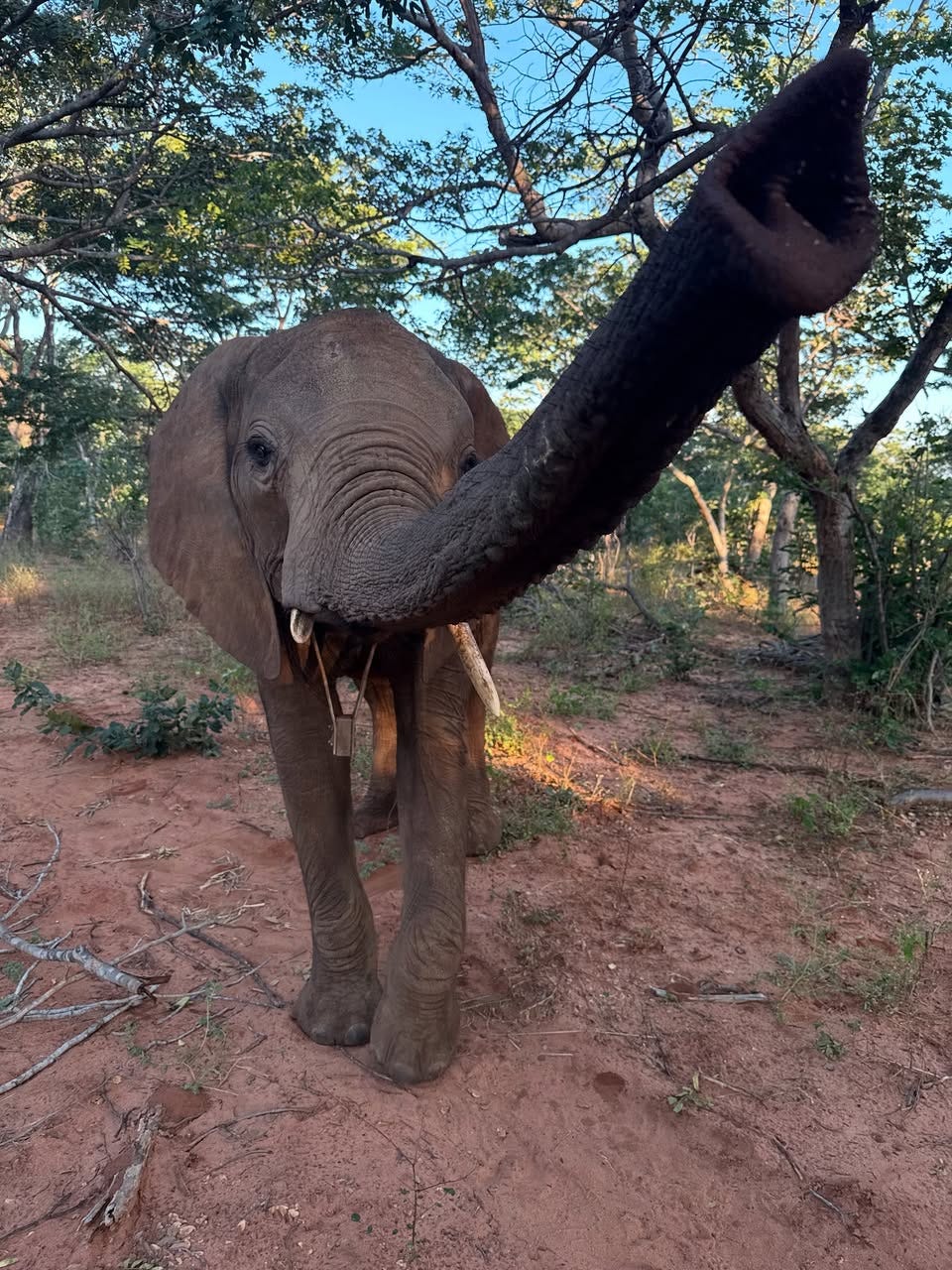
“Sizi holds a very special place in our hearts. Rescued from the Beitbridge area in 2015, with the kind help of our dear friend Vanessa Bristow, she was the second elephant ever brought into our care - growing up side by side with Moyo here at Wild is Life/ZEN.
In 2018, Sizi became part of the pioneering herd of six elephants translocated to Panda Masuie. Since then, she has blossomed into a gentle, stoic young elephant - tall and slender, as is so often seen in elephants from her region.
Sizi’s calm and patient nature draws the younger elephants to her. She has also been a steadfast friend to Moyo, offering comfort and companionship during Moyo’s own time of healing.
A capable wild elephant in every sense, Sizi has spent extended periods roaming free, sometimes joining wild herds. Her journeys have taken her as far as Hwange National Park and across the border into Botswana. Most recently, she spent a few weeks exploring the wild with some younger elephants, travelling all the way down to the Matetsi River before making her way back to the bomas.
Through her time at Panda Masuie, Sizi has become an invaluable part of our rewilding story. Her deep knowledge of the wild and her gentle mentorship are guiding many of the other elephants as they learn to reclaim their natural lives.
Here’s to Sizi - teacher, friend, and true spirit of the wild.”
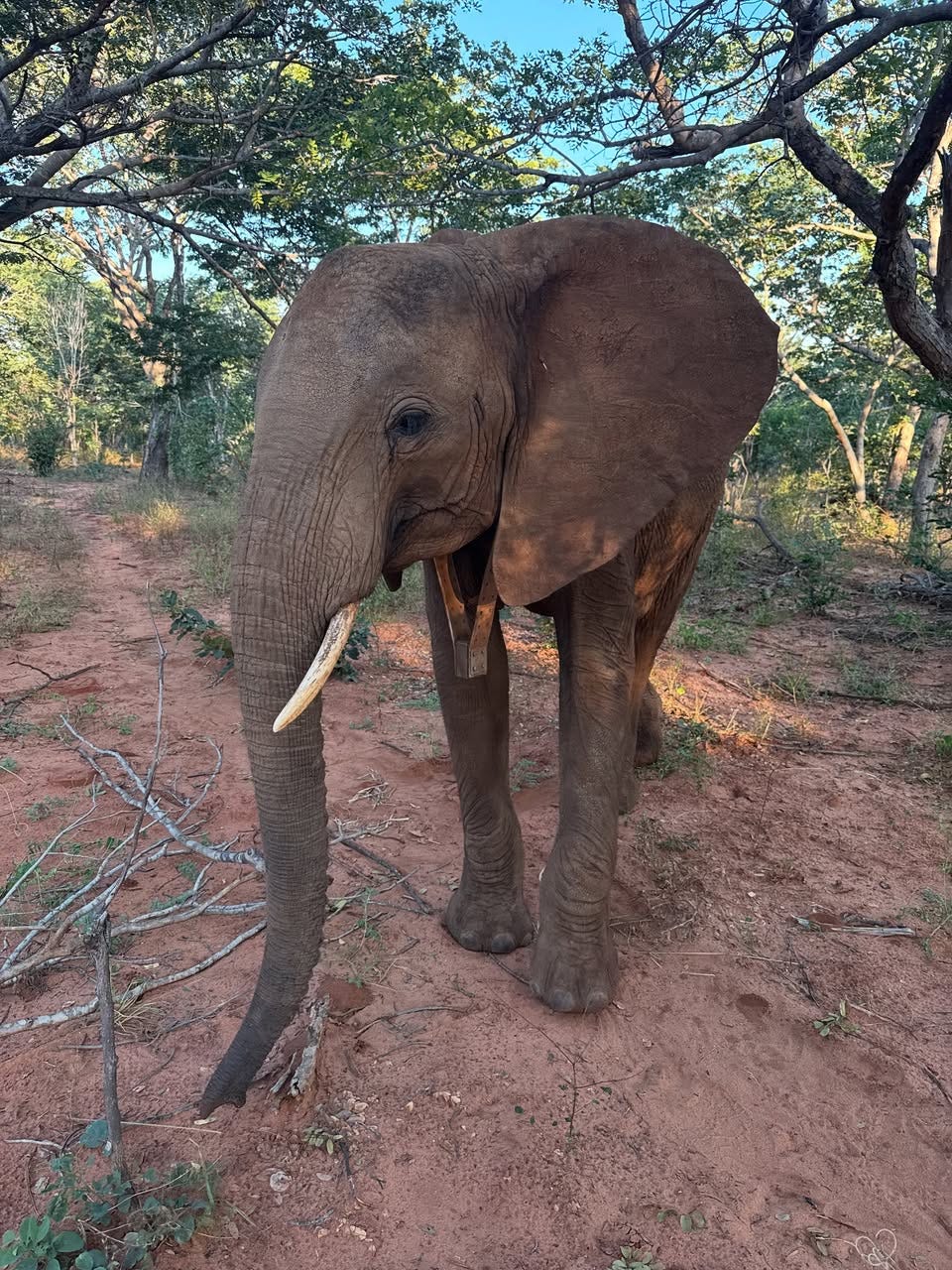
Those of you who read my piece earlier this week about the elie who had a snare caught around her tusk will be happy to know that she is now enjoying a life of freedom with her little herd, here close to Panda Masuie.
Who knows, she and Sizi may even become friends!
Thank you David…Life is sacred , a blessing to have a body to carry us around and we are mindful of what we consume ,blessing each meal with gratitude, we release what we don’t need as in every part of our life…our homes are our sanctuaries, we keep them sparkly clean ever grateful for the roof over our heads….i view my bathroom as a beautiful sacred space where my body’s health is maintained and I am grateful for every flush ( sewers) and shower (clean water systems) taking nothing for granted as I think of it all as a metaphor really for letting go of the me and becoming the One .🥰
thank you David for taking the time to share your gentle and thoughtful teachings. I love how direct you are but how kindly you offer the realities. I hadn’t quite connected digestion and elimination, which is so clear in bodywork, into the impermanence realms. This brought me to other realisations about processes in general. I’m very process oriented in my therapeutic work and realise of course the process is about impermanence (as opposed to working on anything fixed). This is a great revelation for me work wise. Much gratitude. And visits to the loo will be changed hereafter!