

Happy Solstice Dear Readers!
Whether you are experiencing the longest day of the year today, or the shortest, I hope that this weekend brings you opportunity for peace, gratitude and wellbeing.
On a house-keeping note, if any of you are still receiving duplicate newletters, please let me know by replying to this email and telling me. I’ll do my best to fix this for you.
Now … on with today’s wisdom from my lamas …
Buddhists are in the business of mind-training. Thought transformation. There are a myriad such practices to suit people with different personalities, lifestyles and at varying stages of inner development. And as I highlight so often, all of them operate at one or two different levels: the conventional and the ultimate.
Conventional mind training
Conventional mind training focuses on how we experience reality here and now. Our homes, relationships, work, the thoughts we have about ourselves and others. All our regular stuff.
Mind-training practices at this level belong to the ‘worldly’ category, and unsurprisingly we encounter them a fair bit in psychotherapy. To use an obvious example, two and a half thousand years ago Buddha showed that by monitoring our thoughts we are better able to manage them. These days, this concept is considered foundational mindfulness practice. The more we’re able to harness mind-training practices like this, the greater our capacity for equanimity, happy relationships and effective worldly actions. Better lives in the here and now.
Recollecting ultimate reality
What I’d like to focus on today is mind training at the ultimate level. This is the level, affirmed by quantum science, which says that everything that exists depends for how it exists to us on our minds. ‘Show me the thing that exists independently from your mind’ is a favourite question of our lamas. A rhetorical question, because if our mind doesn’t engage it, it doesn’t exist for us.
Or in the words of physicist Sir Arthur Eddington, “The physical world is entirely abstract and without ‘actuality’ apart from its linkage to consciousness.”
This ultimate level, the nature of reality, is a profound subject, and one we circle back to in different ways because it represents the heart of Buddha’s teachings. Everything we are taught, including worldly mind-training practices, lead us to shunyata. My purpose here is not to repeat the core elements of shunyata – you’ll find an introductory video to it here – but rather to explain how to bring our awareness of it into daily life.
‘But, but, but-’ I know some of you may be thinking. ‘I don’t really get shunyata! It’s a slippery fish subject. There are moments I think I have it – then it’s gone! What’s the point of constantly trying to recollect something that I don’t fully understand? It’s beyond me! Why can’t I just be a decent person?’
The point, simply, is that we will never understand shunyata unless we think about it. Even if only momentarily, at different times of the day and in different states of mind. When we do, however, we start pressing different pieces of the shunyata jigsaw into place.
That, at least, is something we are consciously aware of. But we’re also doing something that’s radical. Something that transforms our experience of reality in a way that no amount of worldly mind-training ever can: we are starting to undermine the false basis on which we conventionally see things – including ourselves. We’re beginning to appreciate with more moment-by-moment clarity how we are making everything up. Being a decent person is all well and good. But without understanding shunyata, we will never break out of the web of delusion in which we are unknowingly trapped.
The three spheres
This is a process so monumental, so transformative, that it is sometimes likened to removing the canvas from a painting. The painting is the mistaken way that we see ourselves and others - that is, existing inherently, quite separately from our minds. Without a canvas, with nothing for the paint to hold onto, this entire mental fabrication collapses. We are left with a clarity about the way that things do exist.
This process of awakening, of attaining insight and permanent freedom from samsara – a mind afflicted by karma and delusion – is accelerated when we engage in the practice of the three spheres.
Despite the somewhat astronomical-sounding name, the spheres refer specifically to recollecting as much as possible during the day that:
I have no inherent existence.
Other beings and phenomena have no inherent existence.
My actions have no inherent existence.
By way of a reminder, in affirming that someone doesn’t exist inherently, we are not saying that they don’t exist. Only that the way they exist, for us, depends on our minds. Or to be more comprehensive, that they exist in dependence on parts, causes and our mind.
Recollecting these truths during the course of each day might seem dryly cerebral. But it is the direct antidote to our false assumption that everything is coming from ‘out there.’ We remind ourselves that the rudeness of a client, the geniality of friends, the vileness of a politician and even the adorableness of our cat is actually coming, at least in part, from our own minds. We’re taking ownership of our creation. Responsibility for the way that things seem to us. That fact alone is ground-breaking.
Combining bodhichitta with shunyata
In articles about bodhichitta, I have explained how we try to graft onto daily actions the recollection of bodhichitta motivation. Making a cup of tea for a loved one is a karmically small but positive deed. But if, as we do this, we think: ‘By this act of generosity may I attain enlightenment for the benefit of all living beings,’ we turbo-charge an act of modest goodwill into an expression of infinite altruism. Keep on recollecting this motivation enough and we start to find that we are spontaneously motivated to help others with a bodhichitta motivation. The mask becomes the person.
With the three spheres practice we take this, to use the cliché, to the next level. Making that cup of tea not only do we motivate with ‘By this act of generosity may I attain enlightenment for the benefit of all living beings,’ we also recollect: I have no inherent existence. My act of making tea and the cup of tea itself has no inherent existence. The person I am giving it to has no inherent existence.’ If we then dedicate our action by thinking: ‘May whatever virtue I have just created be a direct cause for all beings to attain enlightenment,’ this is known as ‘a perfectionizer.’ We have perfected our generosity with our bodhichitta motivation, our recollection of shunyata, and our dedication.
A bodhichitta sandwich
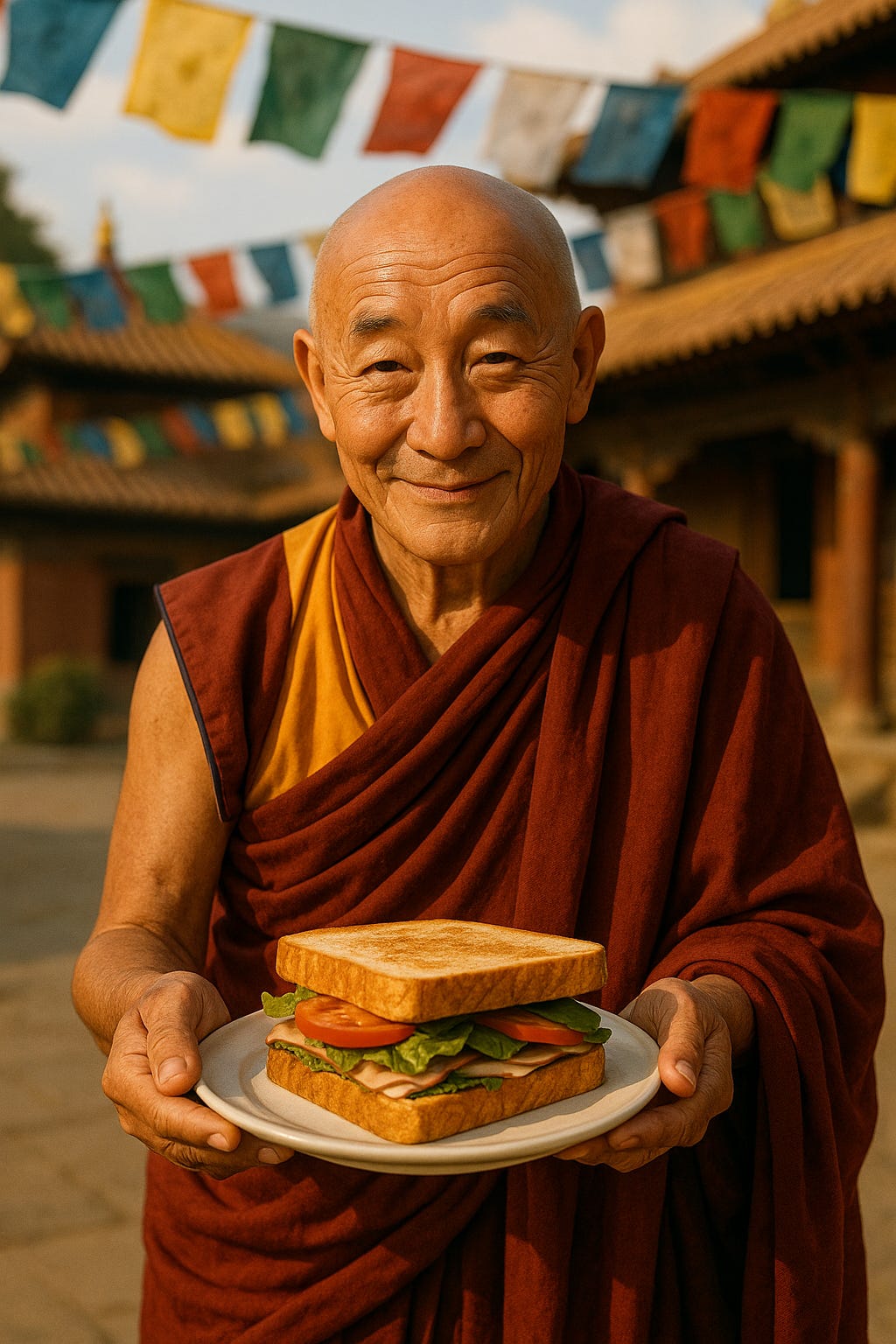
The amount of merit we have accumulated from this action, according to Buddha himself, is inconceivable. Combining the recollections of bodhichitta and shunyata this way creates virtuous karma that will never be exhausted. It also creates a direct cause for our enlightenment. I personally think of it as a ‘bodhichitta sandwich!’ From even the most mundane act of generosity, we create an inexhaustible supply of merit which will ripen outside samsara – it other words, one that will result in our enlightenment.
‘There’s a lot of recollecting going on there,’ you may think. To begin with, true. But as Geshe Thuben Loden always used to say with his Tibetan accent ‘With accountants, everything gets easier’ – meaning, with acquaintance, with practice, with familiarity, our recollection of bodhichitta and shunyata becomes more fluent, swift and ingrained.
All the same, as a wise Dharma teacher reminds us, as a catch-all solution, it’s always a good idea to start each day with the motivation: ‘may my every virtuous action today be a cause for all living beings to attain enlightenment.’ And to end each day with the dedication: ‘may whatever virtuous action I have done today be a cause for all living beings to attain enlightenment.’ We shouldn’t think of these as a substitute for not being mindful during the day, but more as a kind of karmic safety net.
These teachings I’m sharing with you are, by the way, very precious and rare. You won’t hear them at introductory Dharma talks. Or even in many classes. I don’t want to keep our virtual sangha in the paddling pool. I’m not interested in only dispensing useful but superficial ideas that work at a conventional level, making us temporarily comfortable but not addressing the fundamental issue. We can do better than that! I believe that we are a group with sufficient maturity and awareness to get to the heart of Buddha’s teachings. A group wanting to extract the maximum meaning and benefit from whatever remains of our lives. Hence focusing on the most important and transformational practices.
We can recollect the three spheres every time we do something that involves cleaning and purifying - taking a shower, using the bathroom, washing dishes, cleaning the house. Every time we are generous – making tea/coffee, preparing a meal, giving a lift, filling the birdbath, making a donation. Every time we make an effort to study the Dharma – reading a relevant book, watching a YouTube teaching, opening an article like this one. There are plenty of opportunities each day for making bodhichitta sandwiches!
I want to highlight one particular benefit of the three spheres practice. We sometimes hear it said that showing generosity to others is a form of selfishness: we only do it because it makes us feel good. I’ve even heard it said that we should resist such acts because of the sense of lording it over others that it creates. ‘I am better than you’ is the subtext sometimes said to pervade all such actions.
I don’t agree with this viewpoint for a variety of reasons. But from a three spheres perspective, by recollecting the fact that I have no inherent existence, nor the other being, nor the act of generosity, who is the ‘I’ lording it over someone else? Who is better than the other being? That whole paradigm just doesn’t accord with reality. When we understand shunyata even as a mere idea, there is no inherently existent being to be proud of!
I know this has been quite an intense post. We’re dealing with the highest wisdom – Buddha taught none higher than the truth of shunyata. But by practicing the three spheres, by deliberately bringing to mind how things exist, we are antidoting our samsara. Beginning to peel that canvas away from the paint. Starting on a process that must inevitably result in our attaining a permanent and transcendent insight into the nature of reality, a state in which we not only experience abiding bliss, but are incomparably better placed to help others.
Bodhichitta sandwich recipe
Motivation: ‘By this act of purification/love/compassion/and so on be a direct cause for me to attain enlightenment for the benefit of all living beings.
Recollection:
I have no inherent existence.
Other beings/phenomena have no inherent existence.
This action has no inherent existence.
Dedication: May this act of purification/love/compassion/and so on be a direct cause for all living beings to attain complete and perfect enlightenment.

I am pleased to share a couple of photos and update just in from ROKPA Support Network, one of the charities we collectively help.
Above is Shylet, ready for business. Shylet has transformed her life through a ROKPA start-up loan to launch her vending business, bringing fresh produce to the community.
With a growing base of loyal customers she can now provide her family and purchase essential items, including warm clothes for her son Blessing, who has learning challenges. This venture has both enhanced her financial stability and boosted her confidence and social standing.
Micro-financing is one of the ways that the Dalai Lama’s Cat subscriber group collectively helps people in Chitungwiza.

Meet Kunashe. When she first arrived at the ROKPA centre, she could only crawl and needed assistance for daily activities. Thanks to our dedicated therapist, she learned to stand and took her first baby steps. Now, look at her go! She walks well on the treadmill and dreams of walking faster, while also perfecting her balance and gait. With determination and support, there will be no stopping her!
My heartfelt thanks for helping some of the poorest and most disadvantaged people as a paying subscriber!
Thankyou for this wonderful article and these precious teachings. I am so excited to read that you intend to take our virtual Sangha “out of the paddling pool”! How lucky we are. I love the way you distill these amazing teachings into clear and inspiring messages, with practical daily practice advice. It’s a gift to be connected to this “virtual Sangha”. I’m so happy to keep moving through this journey with you all 😊☀️🙏🪷
So many gems in this one 🥰🙏 Thank you for your time and dedication to help all who read this, as well as the beautiful beings you support (and help us to support by passing on our support... I'm certain there is a better way of saying that, but it's not in me today)