


Dear Paying Subscribers,
A brief technical note before this week’s post.
This week I received an email from a someone who became a paying subscriber recently. Subsequently, she has been receiving two emails a week from me - one of them including an ask to become a paying subscriber.
If this has happened to you, please let me know and I’ll get rid of the duplication. Just email me at: safari@davidmichie.com and I’ll sort it out.
Warmest wishes,
David
This post follows on from last week’s, which I recap in the paragraph below.
In my article I explained the idea that our greatest achievement is a more basic one than many of us usually consider. It is, quite simply, that we are on a path of inner exploration at all. Despite whatever pain, loss or devastation each of us endures appearing to arise from causes outside ourselves, we have correctly diagnosed that our continued suffering comes from within. As such, we have some capacity to manage it. Ultimately, to let go of it. And in so doing, to recognise that our true nature isn’t the small human story we generally imagine ourselves to be, but a much wider, more panoramic and transcendent reality.
Where do we go with such a recognition? How do we run with the ball from here? Developing our meditative focus may be an important part of our practice. But given our awareness that focusing on ourselves is at the core of so much of our own unhappiness, how do we meditate without our practice becoming completely self-absorbed? Without it being all about the very me, myself and I who we most wish to let slip from our self-grasping fingertips?!
The Tibetan Buddhist answer to this question is clear: by cultivating bodhichitta, that is defined as ‘for the sake of others, the wish to attain enlightenment.’ We may be the one with our bottom on the meditation cushion. Or who goes out into the world bright with energy. But the themes that percolate through our mind during the day aren’t centred on ‘me.’ On the contrary, we’re doing this for all sentient beings without exception.
Which is all very well as a theory, you may counter. But how do we make such lofty altruism real? How do we cultivate bodhichitta in a way that’s personally meaningful? One method was referred to by the great, 8th century sage Shantideva:
Those who wish to give protection
To both self and other beings,
Should practise the holy secret:
The exchanging of self for others.
“Exchanging self for others,” is much more than only a benevolent idea. It has evolved through the centuries as a five step practice, one that is useful to become acquainted with if we wish to cultivate an authentic basis for our bodhichitta.
My own kind vajra acharya, Geshe Thubten Loden, outlines this practice in his Path to Enlightenment, and I am sharing some key concepts from his teachings here.
Equalising ourselves with others
We start by recognising that all sentient beings are just the same as me in two basic ways: we all wish to avoid even the slightest suffering, and we all wish for more happiness. To which we might add a third point – that, generally speaking, our life is the most precious thing to us and we’ll do all we can to preserve it.
I know that many of you, my subscribers, celebrate with me the truth that we find in Buddhism a tradition putting our pets and all living creatures on an equal footing with us humans when it comes to wellbeing. There is no sense of them being diminished, marginalised or morally inferior when it comes to shared needs and wishes.
When it comes to the pursuit of happiness, whatever our age, gender or species, we are all equal in wishing for happiness and the avoidance of pain.
The advantages of exchanging self with others
Rather than simply leave the concept of equality there, with typical Tibetan Buddhist rigour we are invited to explore the benefits of a bodhichitta practice founded on the idea of such even-mindedness. It’s important to understand that the exchange being referred to is an exchange of preoccupations: instead of thinking about myself and my own concerns the whole time, how about I try shifting the balance and focusing on others? What advantages might that bring?
If I was to ask you to name the happiest people you personally know, I could hazard a guess about your answers. Not the names of the people, obviously, but what makes them tick. I would be surprised if it was anything other than ‘focused on others.’
The most obviously happy person I ever knew was just such a lady. She was my Mum’s vintage, and her days were filled doing flower arrangements for weddings, funerals and the church, teaching reading to kids from underprivileged backgrounds, playing bridge and socialising and going for walks with various people. When you spoke to Mary, she listened. You knew that she was genuinely interested. When you were with her, you were the centre of her world.
As a staunch Anglican, Mary almost certainly hadn’t heard of bodhichitta, or the Buddhist perspective on exchanging self-cherishing for cherishing others. The labels aren’t important. The behaviour is. What mattered was Mary’s state of heart and what arose from it: an irrepressible gratitude for life and resilient wellbeing, even when things didn’t seem to go her way.
It’s kind of interesting that if we were to think of the wealthiest people we personally know, we may well come up with quite a different list of names from the happiest people. Hopefully there may be some overlap, like a Venn diagram.
When I think of the richest people I have ever known, what gave them most joy, what truly enlivened them, was their philanthropic activities. Like my theatre angel friend, George Borwick, who once helped an ambitious young producer, Cameron MacIntosh who asked him to support a theatrical venture that a whole lot of other financiers had turned down. It was a kind of quirky idea for a musical called ‘Cats’. George helped it - and many other shows - happen. That was his happy place.
When we focus on helping others, we ourselves are the first beneficiaries. This is the ‘enlightened self interest’ the Dalai Lama so often refers to. Being ‘wisely selfish.’ Starting with those whom we find it easy to cherish is helpful. Whether that’s theatre producers, fellow congregants, or orphaned elephants in Africa, is not really the point. The important shift is to find those whose interests can offer an alternative focus for our thoughts than ourselves. We begin where it feels most natural and take it from there.
Apart from the immediate relief that comes from this more outward-facing focus, there is the karmic payoff too. As Geshe-la explains in his book:
‘A long life is the result of the positive karma of protecting the lives of others. The compassion that motivates you to protect others’ lives comes from cherishing, or caring for, those living beings. Beauty is the result of patience … wealth comes from generosity … a high position results from respect … all good conditions and higher rebirths have cherishing others as their basis.”
The disadvantages of not exchanging
Here’s a different question: “During the most troubled times of our lives, who has been at the forefront of our thoughts?”
In most cases, the answer is: ourselves.
True, our parents, partners, children or pets may have been front and centre during some of the acute traumas we have shared. Our empathy for their suffering may have felt unbearable. But after the drama or long-running battle, if we continued to carry pain, to suffer, the heart that was breaking was our own.
Certainly when I look back on my most depressed moments, it’s David who was the source of all unhappiness. More specifically, the inadequacies of this failing being. ‘Self-loathing’ may seem quite a different proposition from ‘self-cherishing.’ But what it shares with narcissism is an undue preoccupation with the self, in both cases concretising and reifying a mode of existence that can’t even be found. I describe this in my video What is Shunyata?
We make ourselves miserable thinking too much about ourselves. This is the gist of the disadvantage of not exchanging self-cherishing with other-cherishing.
And just as focusing our compassionate attention on others has its karmic outcomes, so too does self-cherishing. From Geshe-la’s Path to Englightenment:
“All suffering arises from negative karma, which itself is a result of non-virtuous states of mind, which in turn derive from the self-cherishing attitude ... Whatever suffering, problems, unhappiness or difficulty you encounter has self-cherishing as its source. Self-cherishing brings no benefit to others, nor does it produce anything but suffering for you. When you see clearly the disadvantages of indulging the self-cherishing attitude, and compare those with the limitless advantages of cherishing others, you will develop the intention to be rid of the innate habit of self-cherishing.”
The settled conviction in exchanging self with others
This fourth points is essentially a reprise of the first three in which we:
Recognise our equality with all other sentient beings in the most fundamental respects;
Understand the powerful advantages of adopting other-focused attention, both to our current wellbeing as well as the future karmic benefits; and
Similarly understand the disadvantages of feeding our self-cherishing preoccupations, both now and in the future.
We arrive at a settled conviction of the benefits of cultivating an authentic state of heart in which we replace self-cherishing with the cherishing of others. This is no longer just an idea. It becomes our determined goal.
Taking and giving - on cushion and off
From such a conviction we can do two things. Meditatively, we are now in the right space to embark on the practice of taking and giving meditation, or tong len. I have written a post about this meditation, including a guided video commentary here.
Generally, the more we undertake this analytical meditation, mull it over and become familiar with the concepts, the more it shapes our mind. Influences our decisions. Motivates our actions.
As we think, so we become: all begins with thought.
Summary
The start of our inner journey arises with the recognition that both wellbeing and suffering arise from our own minds, much more than material circumstances, challenging as that notion may be. We also come to understand the conventional idea of ‘me’ as being somewhat deceptive: there is much more to who and what ‘I’ am than just a physical body and our personal history. The experience of consciousness, which we may catch glimpses of in meditation, reveals a much more exciting and panoramic reality.
It would be a mistake, however, to devote ourselves to such meditation activity for our own sake alone. Most other beings are simply not capable of understanding the previous paragraph. What about them and their futures? The practice of exchanging self with others reveals the importance of shifting our preoccupations from being dominated by our own wishes, to that of caring more for others. It involves:
Recognising that all sentient beings share the same wishes for happiness and to avoid suffering;
Understanding that when we focus more compassionate attention on others we, ourselves, are the first beneficiaries - we are being ‘wisely selfish.’ This practice also comes with passive positive karmic pay-offs;
Equally, knowing that self-cherishing makes us miserable and is at the root of much negative karma;
Listening, thinking and meditating on the points above develops a heartfelt and settled conviction to practice exchanging self with others;
The meditation practice of tong len helps us embody this concept in a powerful way. In general, the more we familiarise ourselves with the idea, the more it percolates through our day, affects our decisions and shifts the focus of our thoughts. The mind of infinite altruism - ‘for the sake of others, the wish to attain enlightenment,’ - bit by bit becomes a powerful theme in our life, on the meditation cushion or off it.
As we think, so we become.
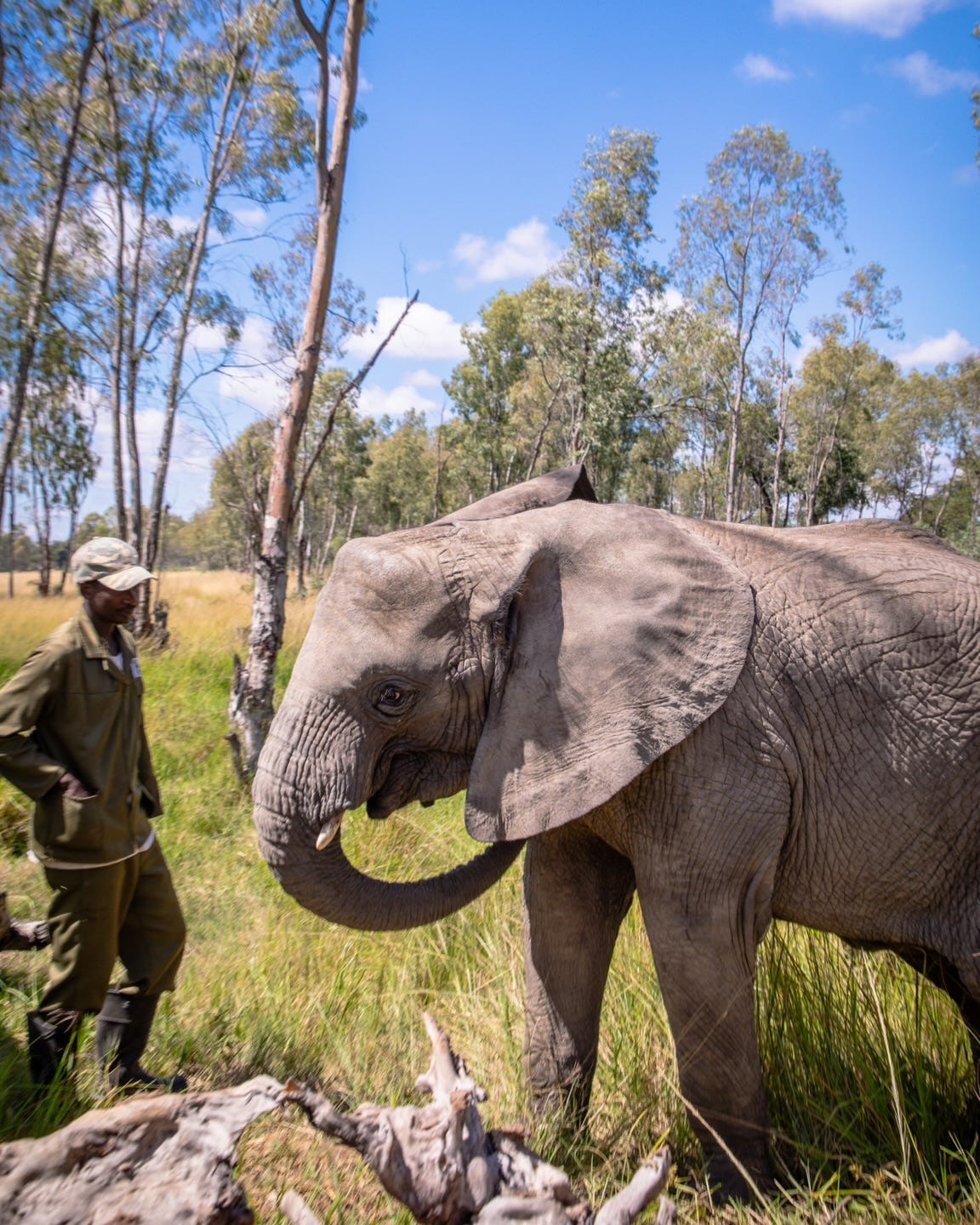
All the very special beings at Wild is Life/Zimbabwe Elephant Nursery are the focus of our compassionate attention. I, personally, find it very easy to feel cherishing thoughts about these orphaned elephants and those who care for them. It is a joy to have them in our lives.
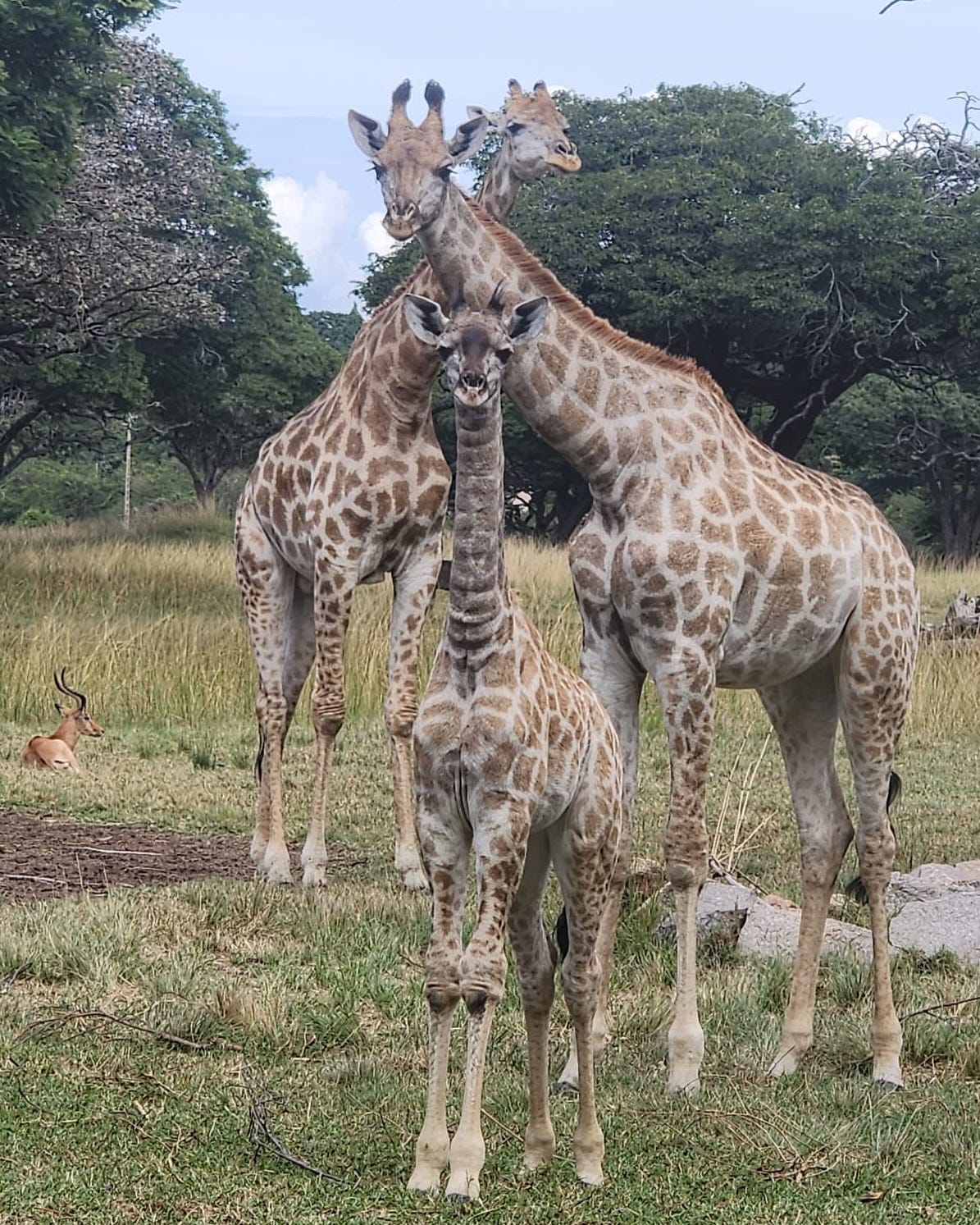
This little one was born in the Southern hemisphere spring. Quite the most elegant and graceful of creatures.
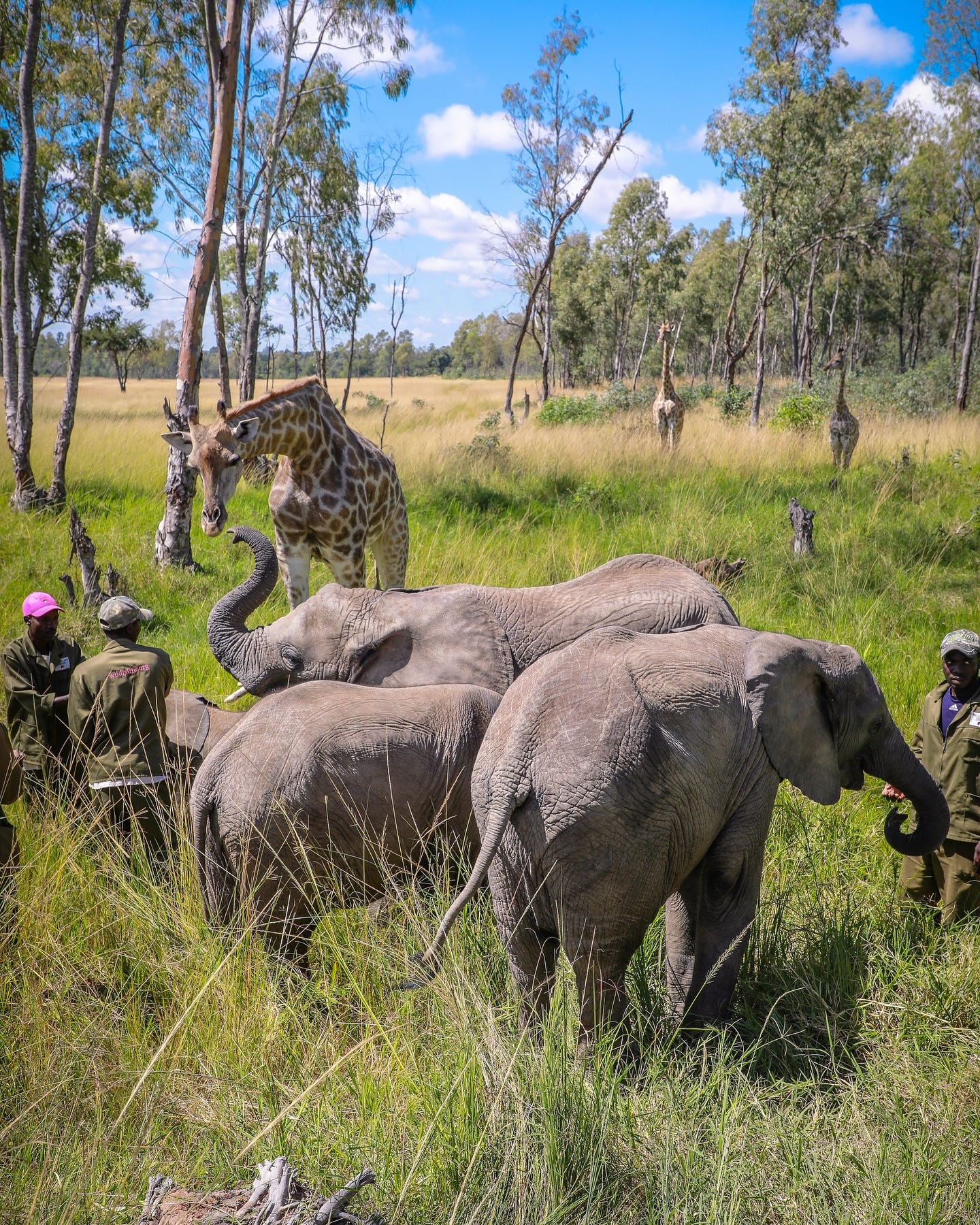
Giraffes can also be very curious. Here they are coming to see what secret goodies the elie-carers are handing out.
As a paying subscriber, you help these sentient beings experience happiness and avoid suffering. Part of our ‘exchanging of self with others’ approach to bodhichitta. What’s not to like?!
Thank you for the excellent reminder regarding the focus of our thoughts and actions. Not only for our enlightenment, but for the wellbeing and enlightenment of all sentient beings. On and off the cushion.
Not always easy, but just last night, I heard once again, on one of HHC’s audiobooks, a pro-tip—“Fake it till you make it.” Little Rinpoche had found her way into a skilled nursing facility. She was putting the idea of bodhichitta into action for the sake of others. A Bodhicatva in training.
I can relate finding it easier to help some (like the people and animals we help through our subscriptions), rather than others who seem not so “deserving.”
And this brings me right back to your post—exchange oneself for others.
Thank you and many thanks for the photos of the elephants and giraffes. Long may they walk this beautiful planet. 🐘🦒💟
Dear David, Again, I thank you for the beautiful and helpful teaching. “For others” as a point of view is like having been ill and finally getting the right medicine. Buddhism is truly extraordinary. The learning never stops. Enjoying hearing and reading Dharma is soothing and encouraging at the same time. I thank you for the time you spend saying it Just Right!
Sending bows of gratitudes and smiles that won’t stop! 🙏🏽🪷☀️